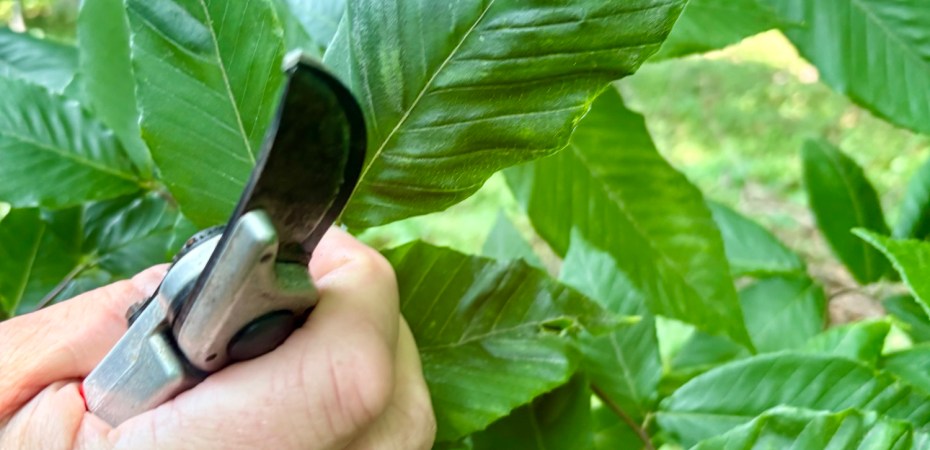
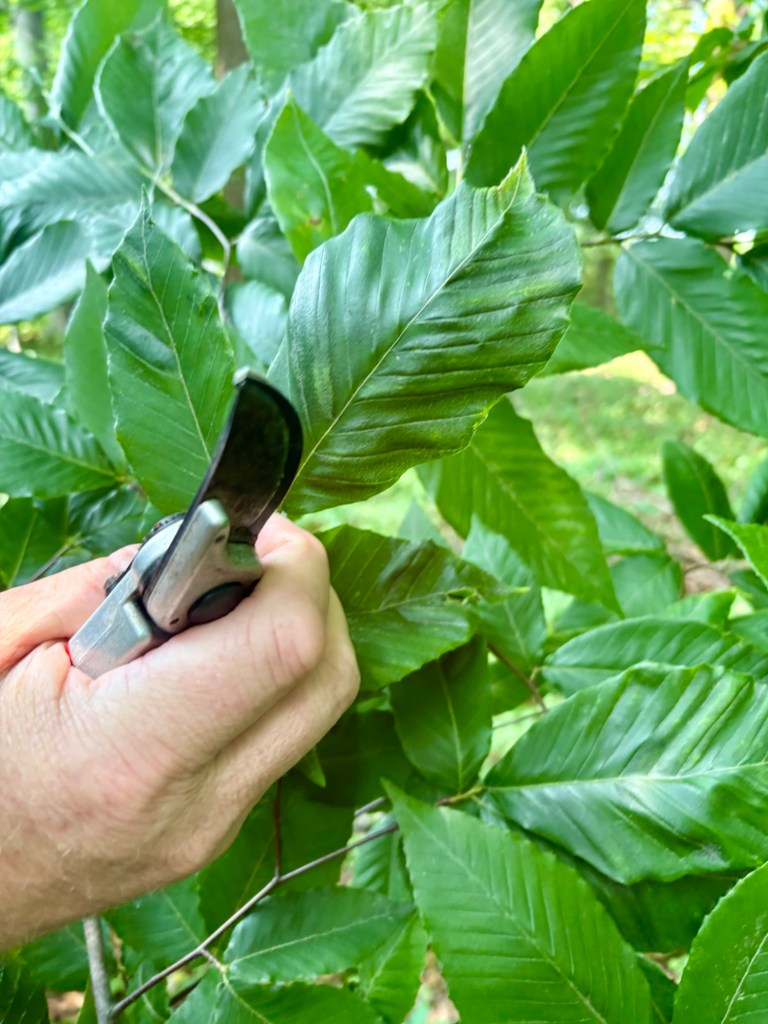
Sigh….being the stewards of our woods is a big deal, but not always fun. Today on one side of the woods my fears have been sadly validated. I feared some of beech trees had funky wilty leaves meaning beech leaf disease.
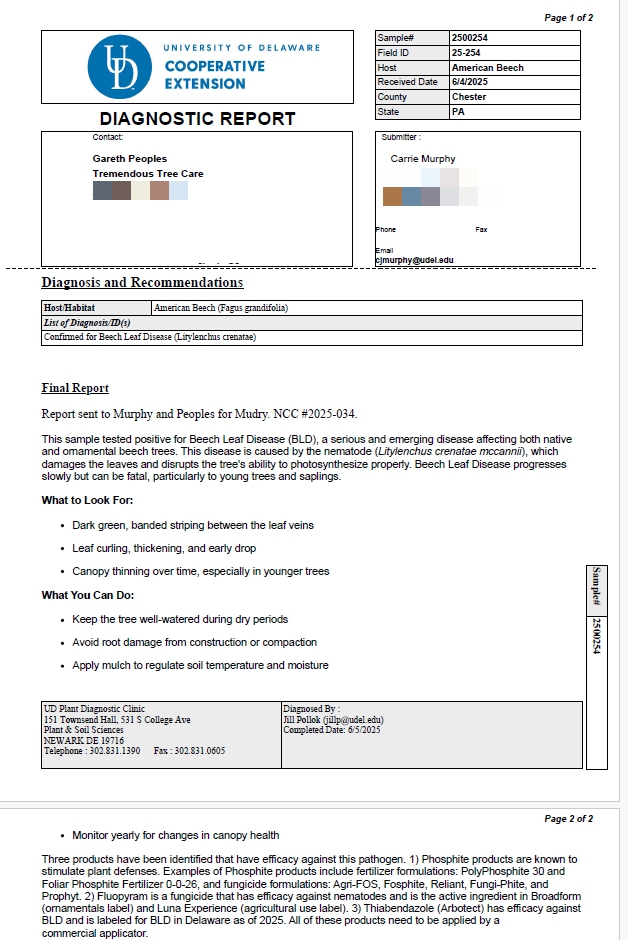
Beech Leaf Disease (BLD) is a fatal disease of beech trees, primarily caused by the nematode “Litylenchus crenatae mccannii.” (Yes I cut and pasted the nematode name!)
This ick is characterized by distinct dark green banding between the veins of leaves, which can spread throughout the tree and eventually kill it. The disease is currently spreading rapidly across the eastern United States and has been detected in Canada as well.
I feel a headache coming on. No not really, but I really hate tree disease. I have a great arborist in Gareth Peeples who owns Treemendous Tree Care, and we have a plan of action.
How the nematodes spread between trees is not fully known or understood yet, but I have read they are known to overwinter in infected buds and migrate to new leaves in the spring. is because of that that we are going to thin out saplings on this one side of my woods. I have a lot of beaches growing more so on one side of the property in woods versus the other.
When you’re pruning whether it’s a tree or a shrub, one of the topics is always airflow. So with thinning out some of the not needed saplings, I am hoping to increase airflow and what we are removing as far as saplings are the ones which are infected with beech leaf disease.
If we ignore this, 1/2 of the woods could very well become decimated. It is also crucial to deal with it, because the people who share other parts of the woods on their property don’t do much preventative work, either pruning or tree health. So it is incumbent upon us to be proactive.
We will treat the bigger affected tree and remove the little saplings.

Beech Leaf Disease (BLD) treatment often involves a combination of approaches, including foliar sprays, root flare injections, and the use of phosphite-based fertilizers. Thiabendazole, as found in Arbotect 20-S, is currently the most effective treatment for BLD, preventing leaf symptoms and dieback. Foliar sprays with fluopyram, like Broadform, can also help control the disease, but are best suited for isolated, high-value trees. And the problem with foliar sprays is if the breeze blows, it doesn’t hit the leaves. If you don’t hit all the leaves right it doesn’t work.
I think I’m going to have affected branches on the bigger tree we are treating removed. They aren’t giant limbs so I don’t see it as a problem. Hopefully Gareth agrees.
I find it fascinating that only some trees are affected. So that might mean that some trees have a greater resistance naturally. I have heard that people studying this disease are looking for that so who knows I might have more people looking at my trees.
Anyway, I was just going to write about all the flowers blooming like the roses, and cleaning up after the week of rain and the weeds that keep growing and then I discovered beech leaf disease.
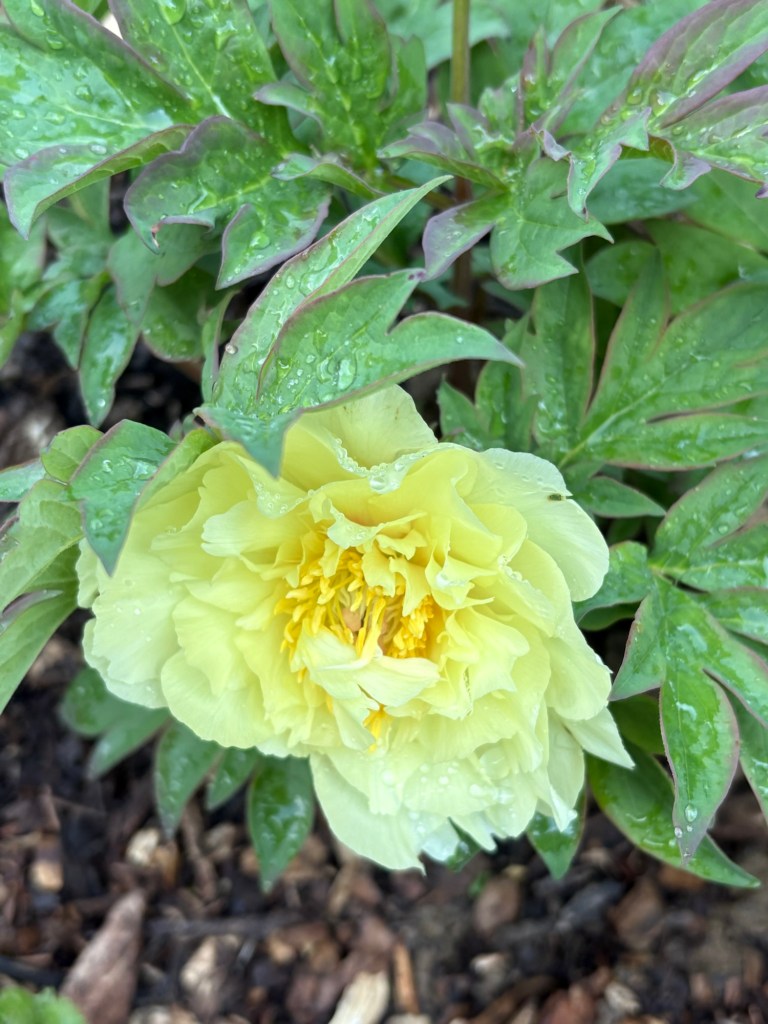
Another bright spot is the cool yellow Itoh peony that I bought from Eleanor’s Peonies bloomed. I hadn’t expected it to since I just planted it, but it gave me one beautiful flower.
I also forgot to mention that I bought one more old Rose from Antique Rose Emporium. Champney’s Pink Cluster dating back to 1811. The ancestor of the noisette roses, this seedling was found growing in the garden of John Champney of Charleston, South Carolina. This is first hybrid between the China and the Musk roses, and some places have referred to this is the first US bred rose. After being lost to rose growers for many years, she was re-identified from a plant sent to the Huntington Botanical Gardens of California in the early 1970s.
Photos show clusters of small, light pink double flowers that have a sweet musky fragrance all through the growing season. This vigourous rose has attractive foilage and is almost thornless.. An old Southern antique rose to use on a fence, trellis or pillar. It can also be grown as a mounding shrub.
I’m not sure if I will regret planting it or not because once it gets established, it will require regimented pruning. But I bought an own root and it’s in a 2 gallon pot.
Other than that, I have a lot of garden maintenance to do. My hydrangeas have all leaked out as much as I think they are going to so I will be taking off the rest of the dead branches.
How does your garden grow?

 the nightgown gardener