

Something caught my eye on social media so I am sharing the screenshot above.
A tiny correction: not all “native roses are good roses.” Rosa Canina or “dog rose” which is NOT Rosa Carolina is considered invasive AND is the host plant which helps spread the mites which carry rosy rosette disease which is actually a virus.
Also, while Rosa Carolina offers some resistance to rosy rosette it is actually not 100% immune to the disease.
So it is important to note that not all roses are the same or considered good. Just because something is considered a native, it doesn’t mean you want to grow it.
Carolina Rose/ Rosa Carolina is truly native to North America. It is a lower-growing, suckering shrub with fragrant pink flowers and bright red hips. The hips are seriously gorgeous.
Dog Rose/ Rosa Canina is considered invasive, and personal experience makes me agree. This wild rose is actually native to Europe. It is more of a rambling, scrambling shrub known for its pale pink or white flowers and red hips. I find the Dog Rose to have much smaller flowers than Carolina Rose and since I was a child I have never seen the Dog Rose around here in PA and NJ to be really pink, it’s more white in appearance.
I have lost roses to rosy rosette. A hybrid tea (John F. Kennedy) and three or four David Austin Roses. I don’t plant Knock Out Roses and they are among the most susceptible as well as being worthless in my opinion.
A brief tangent about Knock Out Roses. They are not exactly cheap, yet you find specials or sales . They look cheap. They have no scent. To me they are engineered, not natural, and they have inherited some of the most problematic traits of modern roses. They are very susceptible to fungal diseases for one. They are also susceptible to pests other than the mites and can be killed off by winter kill, AKA harsh winters.
People are attracted to Knock Out roses for their color and bushy habit. Landscapers are sold on them because they are purportedly carefree.
A nursery owner in Ohio recently waxed poetic about them in a newspaper article. It was pretty puffy and I thought amusing (https://www.cincinnati.com/story/entertainment/2025/05/17/knock-out-roses-are-25-years-old-now-heres-why-that-matters/83510537007/ ) Suffice it to say, I hope he is rewarded for his loyalty to the grower Star Roses.
Star Roses, incidentally, was founded in West Grove, PA which is in Chester County, PA where I live. They were acquired by Ball Horticultural Company of Illinois. That was around 2015. That was the whole Star Roses/Conrad-Pyle thing. Conrad-Pyle predates Star Roses. It’s fascinating see this Wikipedia Page: (https://en.m.wikipedia.org/wiki/Star_Roses_and_Plants/Conard-Pyle )
Also interesting if you are a rose geek like me is that Ball Horticultural Company in 2017 had another acquisition having to do with roses. They acquired the assets of Newflora LLC which had the master license rights in the U.S. and Canada to Kordes Roses, a German company. Kordes Roses has gorgeous cultivars. I don’t own any but have seen them for sale at Heirloom Roses and I think Antique Rose Emporium.
Personally I grow old roses , found roses (Antique Rose Emporium and Heirloom Roses) and David Austin Roses. I prefer bare root roses. And I also prefer as discussed many times in posts here, own root roses. Why I prefer that is because sometimes the root stock takes over even when you have an improperly pruned, as is the case with my Eden Climber. Dr. Huey came calling. (Check this out: https://www.rosenotes.com/2012/03/dr-huey-you-sucker-you.html and https://horticulturetalk.wordpress.com/2010/10/06/suckered-by-dr-huey-a-rose-rootstock-invasion/)
I read somewhere that Dr. Huey is inadvertently one of the most grown roses, but it’s never by anyone’s choice or rarely by anyone’s choice. I noticed that when I was driving through Wayne Pennsylvania, a couple of weeks ago. Huey was everywhere.
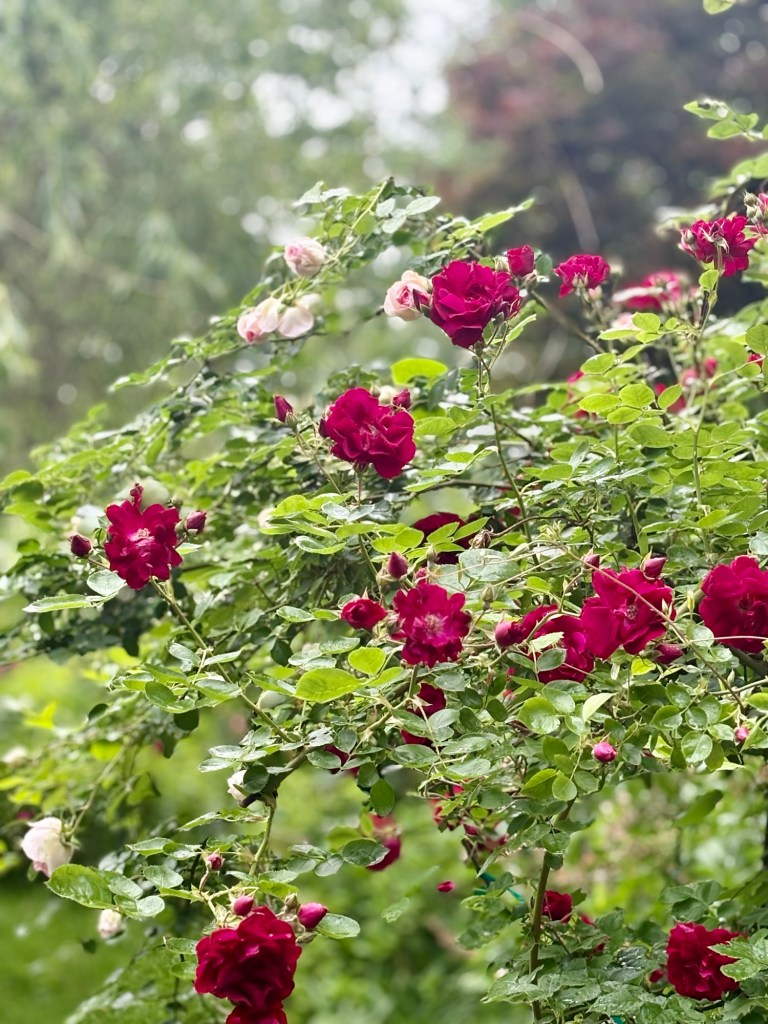
I love my roses. But roses require work, and they thrive on a routine. Regular feeding, watering, dead heading, and pruning at the right times of year. Also, with roses you always need to pick up leaves that hit the ground, particularly during times of great humidity as it cuts down on the problems associated with fungal diseases. I do use BioAdvanced 3 in 1 Rose and Flower Care. It’s a systemic and it helps control disease, it feeds, and it helps control pests.
However, nothing really helps with Japanese beetles, short of picking them off and drowning them. I do use Neem for that. But I never spray except for before 7 AM and maybe after 8 PM and when the heat hits the 90s, sometimes it’s not possible to spray it all because if you do, you will defoliate your plants.
I also use only certain kinds of mulch. Shredded hardwood or hardwood chips and you have to know where those chips and shredded come from because you don’t want to use anything that’s diseased and you definitely do not wish to use anything that has pine in it because pine mulch can be a happy home for mold. I also enrich my soil. I use dried blood, bonemeal, green sand, mushroom soil, grit, and even dehydrated, cow manure, or chicken manure. Roses are heavy feeders so they like good soil and good food.
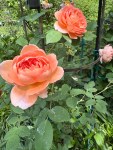
Here are some of my roses:




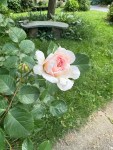
My last word on roses is that I am excited to see how my latest old rose performs once she is established. She is Champney’s Pink Cluster. This rose dates to 1811. In part why I chose it is the house I was born in in Philadelphia was built in 1811 so that was just kind of cool to me. This is considered like one of the first hybridized US roses and it’s a noisettes, which means it will bloom more than once. It was created by John Champneys of Charleston, South Carolina. It is believed to be a cross of Musk Rose (Rosa moschata) and a China rose (possibly ‘Old Blush’). Ironically, I planted her near an Old Blush, which I thought had died, but then it resurrected itself.
So now enough about roses and onto the other part of my post. I think people get a little too obsessed about solely planting native plants and the thing that always amuse me about that is not everything they consider native is actually native and if you look at in that regard, these “native roses.” People consider the dog rose native, but it really isn’t it. It’s from Europe originally isn’t it?
Some plants considered native are what you would consider a garden tourist. Plainly said, they were introduced here and thrive, but that doesn’t necessarily make them a native. Daylilies, foxglove, forsythia, Japanese honeysuckle, burning bush and even daffodils. They all thrive in North America, but they are non-natives. They were introduced making them garden tourists. American boxwood, Queen Anne’s Lace, and Kentucky bluegrass are also non-native.
People love native plants for all sorts of reasons. They support local ecosystems and reported reduced maintenance. They are important in restoring local ecosystems. There’s also a sense of place.
However, non-natives can also offer a similar sense of place because they were also used historically in gardens as our country was settled.
Explorers bought home plants and seeds from wherever they traveled. It also became big business in Victorian times. Plant rustlers. And speaking of rustlers as a related aside? There are Rose wrestlers who have helped to keep old roses alive.
I discovered a great quote when I was looking into all of this from First Lady Ladybird Johnson :
“Native plants give us a sense of where we are in this great land of ours. I want Texas to look like Texas and Vermont to look like Vermont.” — Lady Bird Johnson (First Lady of the United States as the wife of President Lyndon B. Johnson, 1963 – 1969).
Like many other issues in this country, the issue of natives versus non-native plants in your garden has gotten rather polarized. I have seen it within my own gardening group and some people are truly obnoxious about demanding that everyone just grow native plants.
There is that thing called personal choice. I choose what goes in my garden. And sometimes the native species choose for me. Ultimately, I decide what fits.
I go out of my way not to choose invasive plants, and have spent a small fortune removing invasives. Poison ivy for example is actually a native plant. Because it’s a native should I be growing it in my garden even though I’m allergic to it?
So that’s what I’ve got for you my fellow gardeners. I will leave you with links to articles which may be of interest:
https://albopepper.com/natives-vs-non-natives-and-invasive-plants.php
https://www.almanac.com/content/common-garden-weeds
https://www.wnps.org/blog/the-native-plants-in-the-garden-debate-a-case-for-plants
 the nightgown gardener